Real-Time Lead Bidding: How Ping-Post Marketplaces Work
Learn how real-time lead bidding works in ping-post marketplaces. Covers bid mechanics, pricing strategies, and how to maximize revenue per lead.
Rafael Hernandez
Founder & CEO

I hope you enjoy reading this blog post. If you want us to distribute your leads for you, click here.
Author: Rafael Hernandez | Founder & CEO of Lead Distro AI
Real-time lead bidding is a distribution method where multiple buyers compete for each incoming lead by submitting price bids within milliseconds. The highest bidder wins the lead and receives the full contact information. This process, known as ping-post, is the most revenue-efficient way to distribute leads because it creates a competitive marketplace that drives up the price per lead. According to industry benchmarks from the LeadsCon community, agencies using real-time bidding generate 25% to 40% more revenue per lead compared to fixed-price distribution models.
This guide explains how real-time lead bidding works, the technical mechanics behind ping-post distribution, pricing strategies for buyers and sellers, and how to set up a lead bidding marketplace. If you run a lead generation agency or buy leads for your sales team, understanding bidding mechanics gives you a direct competitive advantage.
Key Takeaways
- Real-time lead bidding uses the ping-post protocol, where partial lead data is sent to buyers who respond with bids in under 500 milliseconds.
- Sellers earn 25% to 40% more per lead compared to fixed-price waterfall distribution because multiple buyers compete for each lead.
- Buyers control their spend through bid prices, daily caps, geographic filters, and case type preferences.
- The entire bidding cycle completes in under one second, ensuring leads are delivered while the prospect is still engaged.
- AI-powered scoring can enhance bidding by predicting lead quality before buyers place bids, improving close rates for winning buyers.
How Real-Time Lead Bidding Works
Real-time lead bidding follows a two-step process called ping-post. Understanding each step is essential for both lead sellers (agencies) and lead buyers (law firms, insurance agents, home services companies).
Step 1: The Ping. When a new lead enters the system (through a web form, phone call, or API submission), the lead distribution platform sends a "ping" containing partial lead data to all eligible buyers. The ping includes non-identifying information such as state, zip code, case type, injury severity, and lead source. Buyers never see the prospect's name, phone number, or email at this stage.
Step 2: The Post. Each buyer's system evaluates the ping data against their buying criteria and responds with a bid price (or a decline). The distribution platform collects all bids, selects the winner (highest bid that meets the seller's price floor), and "posts" the full lead data to the winning buyer. The entire cycle, from ping to post, completes in under 500 milliseconds.
This two-step approach protects lead data (buyers only see PII after winning) and creates price discovery through competition. It is the same fundamental mechanism used in programmatic advertising, real estate lead exchanges, and financial trading platforms.
The Economics of Lead Bidding
Real-time bidding changes the economics of lead distribution for both sides of the marketplace.
For sellers (lead generators): Bidding maximizes revenue per lead because every lead is sold at market price rather than a negotiated flat rate. If five buyers bid $75, $100, $125, $150, and $175 for the same auto accident lead, the seller receives $175 instead of the $125 average they might have set in a fixed-price arrangement. Over thousands of leads per month, this premium adds up significantly.
For buyers (attorneys, agencies): Bidding gives buyers precise control over their acquisition costs. A law firm can set a maximum bid of $200 for exclusive auto accident leads in Texas and $150 for the same lead type in Ohio. They pay only what they bid, and they only receive leads that match their exact criteria. Buyers who understand their conversion metrics can calculate the maximum bid that maintains profitability.
Price floors and ceilings create guardrails. Sellers set minimum acceptable bids (price floors) to ensure profitability. Buyers set maximum bids (ceilings) to control costs. The market clears somewhere in between. According to Forrester Research, dynamic pricing models like real-time bidding improve marketplace efficiency by 30% compared to static pricing.
Setting Up a Lead Bidding Marketplace
Building a real-time lead bidding operation requires four components: lead sources, a distribution platform, configured buyers, and reporting infrastructure.
Lead Sources feed the marketplace. These include Google Ads landing pages, Facebook lead forms, SEO-driven organic leads, call tracking numbers, and affiliate network partners. The more diverse your lead sources, the more volume you can offer buyers. Each source connects to your distribution platform via API or webhook integration.
Distribution Platform is the bidding engine. It receives leads, sends pings, collects bids, selects winners, and posts full data. The platform must handle the entire cycle in under one second to maintain lead freshness. Lead Distro AI supports native ping-post with AI scoring, enabling sellers to enhance ping data with predicted quality scores before buyers bid.
Buyer Configuration defines who can bid and under what conditions. Each buyer sets their geographic coverage, case types, daily caps, bid prices, and delivery preferences (webhook, email, CRM push). Properly configured buyers ensure leads route to firms that actually want them, which reduces return rates and improves buyer satisfaction.
Reporting tracks everything: bid win rates, average bid prices, fill rates (percentage of leads that receive at least one bid), revenue per lead, and buyer performance. Use the lead pricing calculator to model different scenarios and optimize your pricing strategy.
Bidding Strategies for Buyers
Successful lead buyers treat real-time bidding as a data-driven operation, not a guessing game. Here are four strategies that consistently outperform:
Calculate Your Maximum Bid from Conversion Data. If your close rate on exclusive auto accident leads is 15% and the average case value is $5,000, each lead is worth $750 in expected value. A bid of $200 to $300 per lead leaves healthy margin. Buyers who know their numbers can bid aggressively and still profit.
Segment by Geography and Case Type. Do not use a single bid for all leads. Bid higher for leads in your strongest conversion markets and lower (or decline) in areas where you have weaker results. A PI firm in Miami might bid $250 for Broward County auto accident leads and $100 for leads from rural North Florida.
Optimize Bid Timing. Some platforms allow time-based bid adjustments. Leads submitted during business hours (when intake staff are available) convert at higher rates than after-hours leads. Adjust bids accordingly.
Monitor and Adjust Weekly. Real-time bidding is dynamic. Buyer competition fluctuates, lead quality varies by source, and conversion rates shift over time. Review your win rate, cost per acquisition, and ROI weekly. If your win rate exceeds 80%, you may be overbidding. If it is below 20%, your bids may be too low.
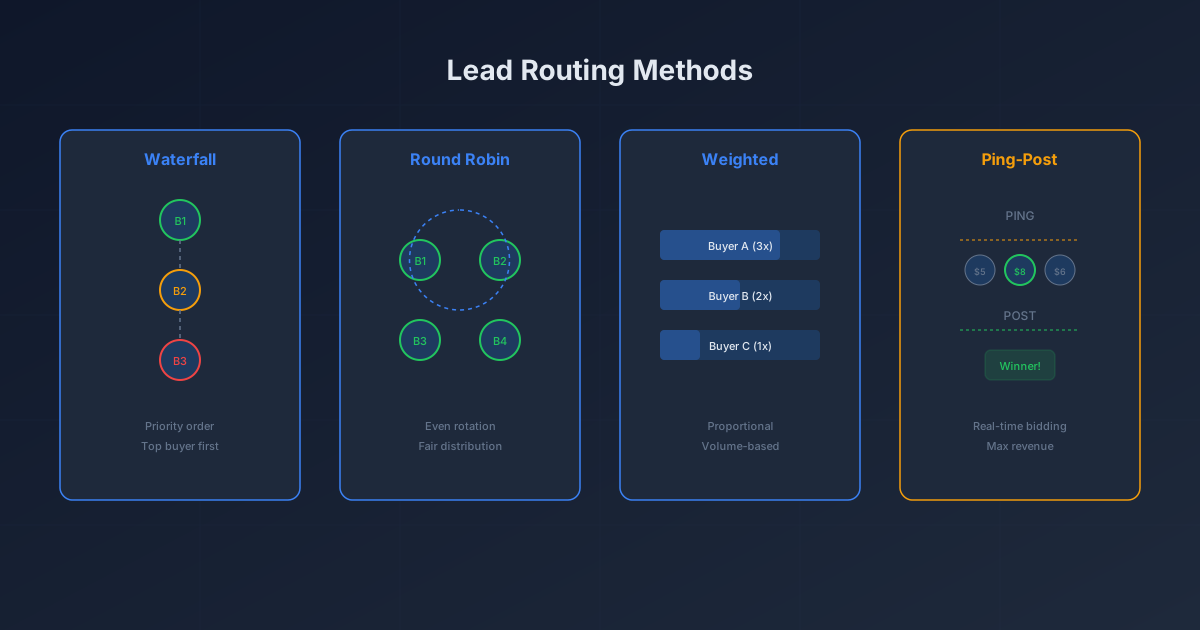
Real-Time Bidding vs. Other Distribution Methods
| Method | How It Works | Best For | Revenue Model |
|---|---|---|---|
| Real-Time Bidding (Ping-Post) | Buyers bid on each lead competitively | Maximizing revenue per lead | Dynamic pricing |
| Waterfall | Leads route to buyers in priority order | Premium buyer relationships | Fixed pricing |
| Round Robin | Leads distribute equally across buyers | Fair distribution, simple setup | Fixed pricing |
| Weighted | Leads distribute by percentage allocation | Volume-based buyer tiers | Fixed pricing |
Real-time bidding generates the highest revenue per lead but requires more buyer management and technical infrastructure. Waterfall is simpler but leaves money on the table when lower-priority buyers would have paid more. Many agencies use a hybrid approach: ping-post for high-value lead types and weighted distribution for lower-value or high-volume categories.
Explore all four methods through the Lead Distro AI product tour to see how they work in practice.
FAQ
What is real-time lead bidding?
Real-time lead bidding is a distribution method where multiple buyers compete for each lead by submitting price bids within milliseconds. The process uses the ping-post protocol: partial lead data is sent to eligible buyers, who respond with bids, and the full lead goes to the highest bidder. The entire cycle completes in under one second.
How much more revenue does real-time bidding generate?
Agencies using real-time lead bidding typically earn 25% to 40% more per lead compared to fixed-price distribution. The premium comes from price competition: instead of selling every lead at a negotiated flat rate, each lead sells at the market-clearing price determined by buyer demand at that moment.
Is real-time bidding only for large agencies?
No. Real-time bidding works for agencies of any size, though you need at least three to five active buyers to create meaningful competition. Smaller agencies benefit from the pricing premium even at moderate volume. The key requirement is a distribution platform that supports native ping-post functionality.
How do buyers set their bid prices?
Buyers calculate maximum bids based on their lead conversion rate, average case or deal value, and target cost per acquisition. A buyer closing 10% of leads with $3,000 average value has $300 expected value per lead. They might bid $100 to $150 to maintain healthy margins while winning enough volume.
What happens if no buyer bids on a lead?
If no buyer submits a bid above the seller's price floor, the lead can be routed through a fallback waterfall to fixed-price buyers, held for resubmission during higher-demand hours, or sold as a shared lead to multiple buyers at a lower price point. Most platforms support configurable fallback logic.
Conclusion
Real-time lead bidding transforms lead distribution from a fixed-cost operation into a dynamic marketplace. Sellers maximize revenue per lead through buyer competition, while buyers gain precise control over acquisition costs and lead quality. The ping-post protocol that powers this marketplace completes in under one second, ensuring leads are delivered while the prospect is still actively engaged.
Lead Distro AI supports native ping-post bidding with AI scoring, geographic targeting, daily caps, and real-time P&L reporting built in. Whether you are setting up your first bidding marketplace or migrating from a fixed-price model, the platform handles the entire workflow.
Ready to launch a real-time lead bidding marketplace? Start your 14-day free trial and configure your first ping-post campaign in minutes.
About the Author
Founder & CEO of Lead Distro AI & Great Marketing AI
UC Berkeley graduate and former software engineer at Microsoft. Rafael built Lead Distro AI after managing over $10M in ad spend for pay-per-lead agencies, including running campaigns for Neil Patel. He combines deep software engineering expertise with hands-on performance marketing experience to build tools that help PPL agencies scale profitably.
About Lead Distro AI
Lead Distro AI: AI-Powered Lead Distribution for Agencies
The modern platform for pay-per-lead and pay-per-call agencies. Route, score, and deliver leads with AI-powered automation and real-time P&L tracking. Built for lead brokers, sellers, and buyers across legal, insurance, mortgage, solar, and home services verticals.
4 Distribution Methods
Waterfall, Round Robin, Weighted, Ping-Post
Real-Time P&L Reporting
Track revenue, costs, and profit per campaign
AI Lead Scoring
Score every lead before routing to maximize conversion